FAST Operating Model
Formation Committee
April 2026 (revisions in red)
Introduction
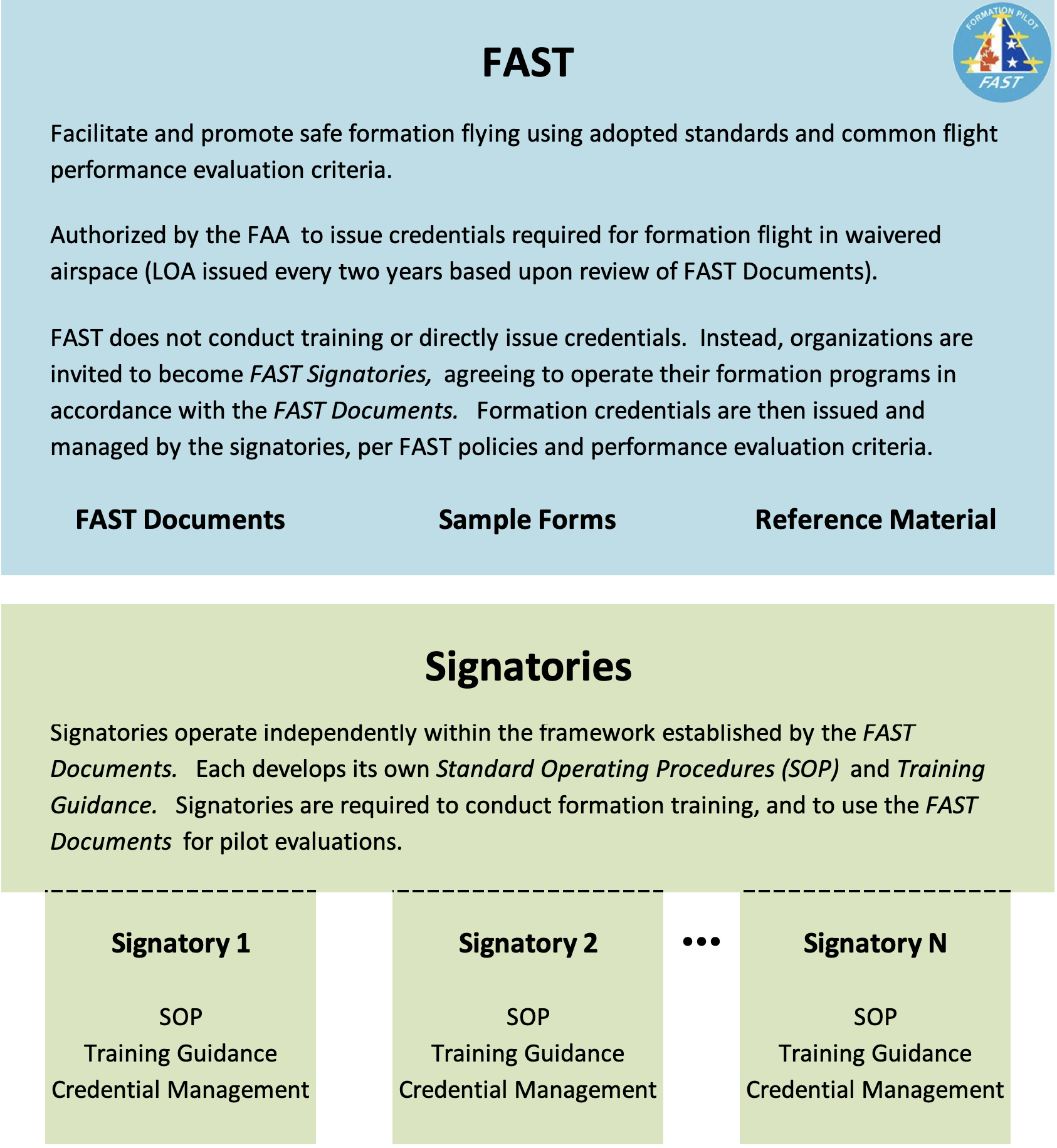
The FAST mission is to facilitate and promote safe formation flying, and it is also authorized by the FAA to oversee the issuance of formation credentials to qualified pilots. This is accomplished indirectly through participating organizations known as FAST signatories, which conduct formation training and issue formation credentials representing FAST qualifications. Each FAST signatory appoints one representative to serve on the FAST Board of Directors.
FAST signatories are required by the
FAST Foundation and Principles (FF&P) to conduct their formation programs in accordance with certain
FAST Documents (FF&P, Practical Test Guides/PTGs, Formation Maneuvers Guide, Radio Comms & Signals Guide, FAST Airshow Operations), their
Standard Operating Procedures (SOP), and their training materials, which must be derived from the the
FAST Documents.
The
FAST Documents do not include formation training materials; instead, signatories must develop or adopt their own, and the five founding FAST members, including NATA, adopted the T-34
Formation Flight Manual in the mid-1990s. Signatories sometimes refer to their training manual as their
Formation Manual. Over time, some signatories developed their own formation manuals.
The
Formation Knowledge Guide (FKG)
version 3.0 is available from FAST as a reference document, although it may be adopted by any signatory as its formation manual. This means the
FKG does not define standards and procedures across FAST signatories, and can only be authoritative for the signatories that choose to adopt it. Any modifications that a signatory makes to its adopted formation manual must continue to conform to the
FAST Documents. Further, there is no requirement for any signatory to conform to
FKG modifications made by another signatory, and there is no requirement for a signatory using one version of the
FKG to adopt subsequent revisions when they become available.
How is FAST standardization achieved (if there isn’t a FAST training manual)?
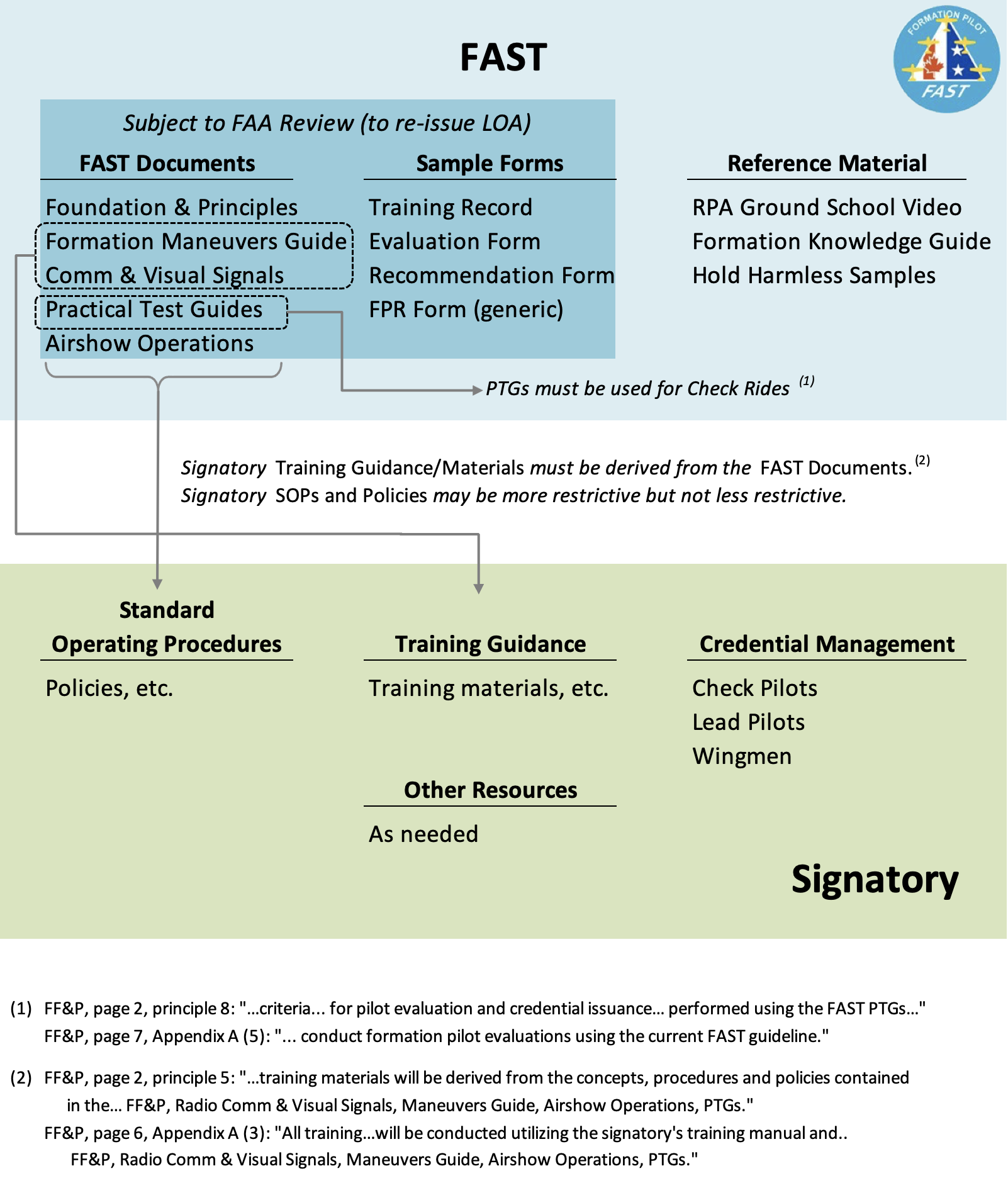
All formation materials developed or adopted by signatories must conform to the
FAST Documents, which sit at the top the document hierarchy and are authoritative. While signatory formation materials may not conflict with the
FAST Documents, they are permitted to cover topics or procedures more broadly than the
FAST Documents.
Also, all pilot evaluations and proficiency endorsements must be performed using common criteria, in the form of the
FAST PTGs and the
FAST Evaluation Form. Additional information in the signatory formation materials may therefore not be used to establish different performance
criteria.
What about omissions in the FAST Documents?
The
FAST Documents have stood the test of time remarkably well (more than three decades). Still, corner case omissions have been identified. Where necessary, these gaps are addressed in our NATA documents. Note that there is no requirement for signatories to address such omissions in the same way, meaning that, where the
FAST Documents are incomplete, minor procedural differences may exist between signatories. Therefore, just as Leads must be aware of differences when briefing flights comprised of dissimilar aircraft, they should be aware of minor procedural differences when briefing flights comprised of pilots from different signatories.
How has NATA met its FF&P obligations?
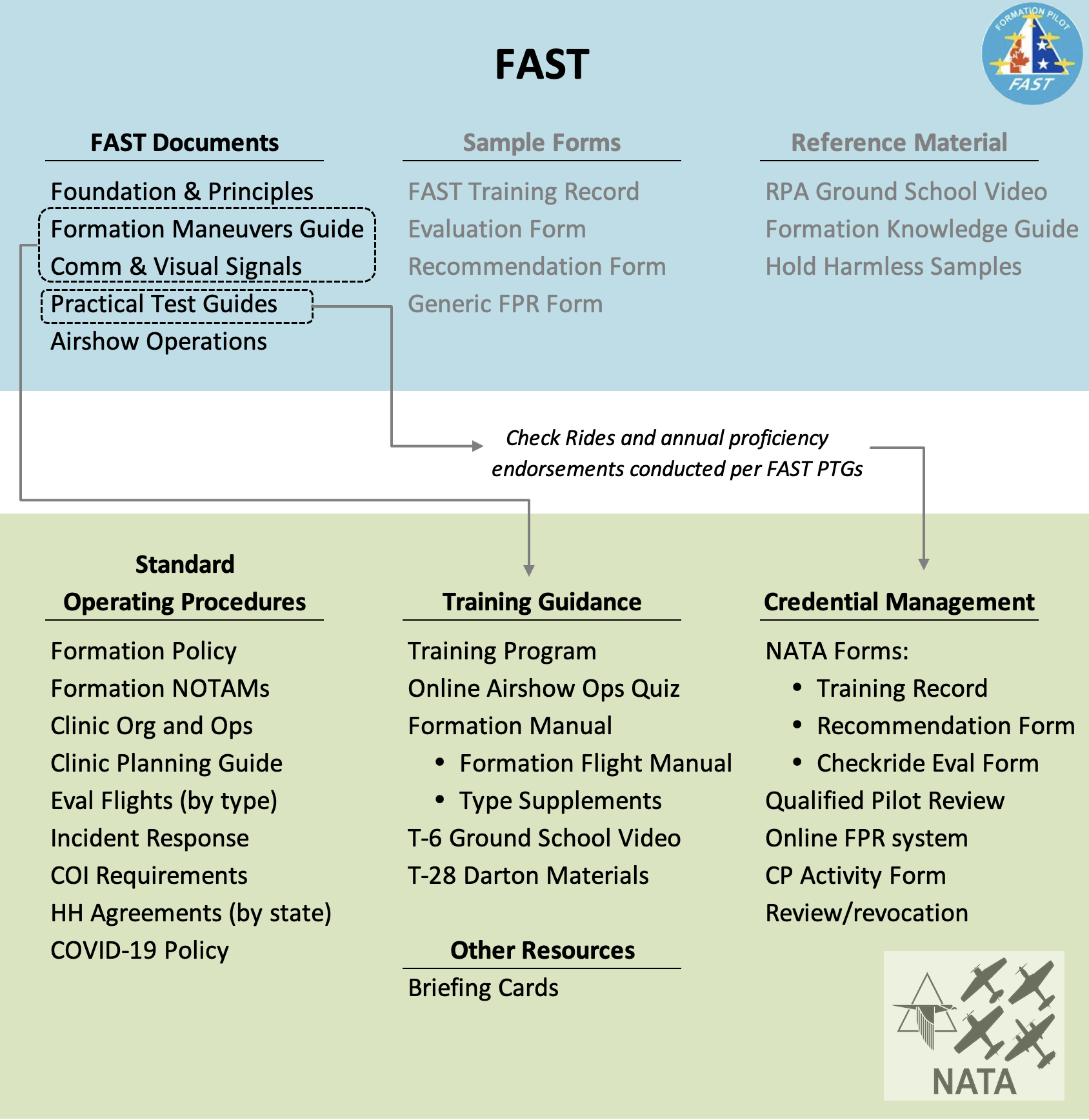
Alongside a number of NATA policy documents and other training resources,
NATA created its own formation manual in 2026, replacing FKG versions 1.2 and 2.0 that it had used for approximately 10 years. Noteworthy changes between the NATA manual and FKG 2.0 are listed on the fist page of the manual. NATA also uses
Type Supplements to provide additional type-specific information to pilots.
FAST Operating Model Diagrams
The following charts are presented to help understand the relationship between FAST and NATA, and between the FAST and NATA documents. The
FAST Documents referenced are authoritative.
FAST Operating Framework
FAST Document Hierarchy
NATA Formation Program
Copyright © 2026 NATA